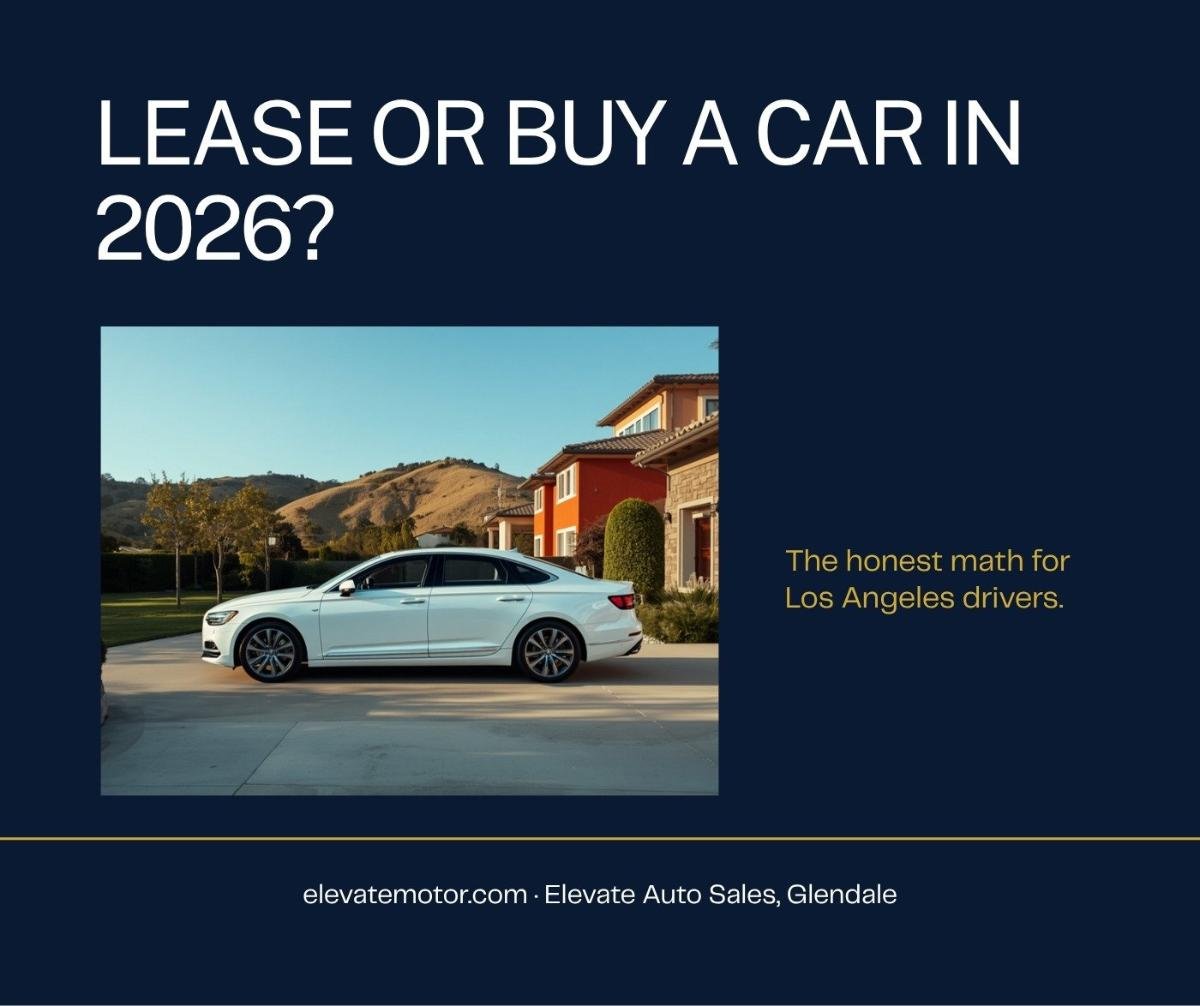
Whether to lease or buy a car in Los Angeles in 2026 comes down to miles and time. Lease if you drive under 12,000 miles a year, want the lower payment and like a new car every few years. Buy if you drive a lot, plan to keep the car five years or more, or want to build equity.
Quick facts
Compare this month's lease specials against your loan quote; every one is priced the same way.
When you buy, you pay for the whole car and own it when the loan ends; when you lease, you pay for the part of the car's value you use over two to three years, then hand it back.
You take out an auto loan and make payments until it is paid off. Then the car is yours outright: no mileage limits, no lease-end charges, no rules about what you do to it. The trade-off is a higher payment, and sales tax on the full price up front.
You pay for the car's depreciation during the term, typically 24 to 39 months, plus a finance charge, so the payment is lower. At the end you return the car, buy it for the residual value in the contract, or lease something new. To see how the payment is built, read the 3 numbers that decide every lease deal.
On the same $45,000 SUV with $3,000 due at signing, leasing runs around $550 a month in our example and financing runs around $832, so the lease costs about $282 a month less for the first three years.
Based on 2026 market averages, a new car costs just under $50,000 nationally, loan rates average about 7% APR and run higher for lower credit tiers, and the average new-car loan payment is above $750 a month. That is why about 24% of new cars financed this year are leased. One car, as an example and not a quote:
| $45,000 SUV, $3,000 due at signing, tax excluded | Leasing (36 months) | Buying (60-month loan at 7% APR) |
|---|---|---|
| Monthly payment | About $550 | About $832 |
| Due at signing | $3,000 | $3,000 |
| Paid through month 36, including the $3,000 at signing | $22,800 | $32,952, with 24 payments left |
| Own the car at the end? | No | Yes, after month 60 |
| Mileage limit | 10,000 to 12,000 a year | None |
| Maintenance | Low, under factory warranty | Higher once the warranty ends |
| End of term | Return, buy out or lease again | Keep it, sell it or trade it in |
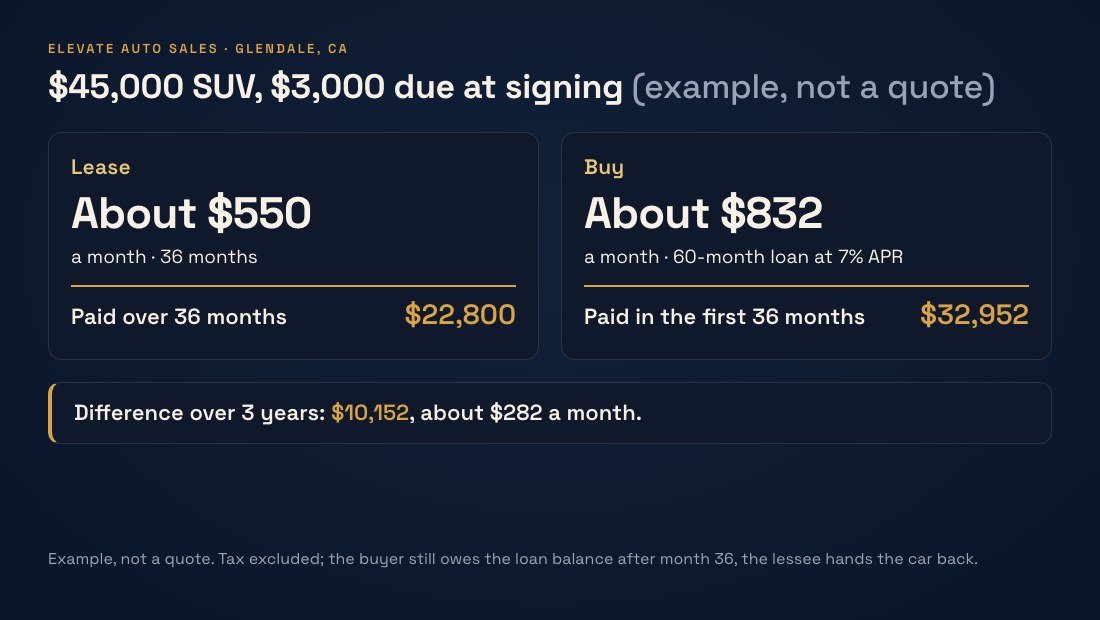
The math: $42,000 financed over 60 months at 7% APR, before tax and registration, is about $832 a month, so 36 payments plus $3,000 at signing come to $32,952. The lease is 36 payments of $550 plus $3,000, or $22,800. The gap is $10,152 over three years.
Payments vary with your credit tier, the car and that month's incentives, so send us your city and model through Request a car and we will show you how the lease compares with financing the same car.
When you buy, California charges sales tax once on the full price of the car; when you lease, tax is charged on each monthly payment as you make it, so you only pay tax on the part of the car you use.
Example, not a quote: at a 10% rate, tax on a $45,000 purchase is $4,500. On a $550 lease payment it is $55 a month, or $1,980 over 36 months, plus tax on what you put down at signing. Your rate follows the city where the car is registered.
LA County sales tax goes up on October 1, 2026. A purchase signed before that date saves the difference once, while lease payments made after it carry the new rate even on an older lease, unless the contract locks in the rate. Our guide to the LA County sales tax increase and your lease payment has the city-by-city rates.
If October 1 matters to your decision, call or text us at (818) 797-9795 and we will tell you what it changes.
Leasing makes the most sense when you drive moderate miles, want the lowest monthly payment and like a new car under warranty every few years.
Lease payments can run $200 to $300 a month below a loan on the same car. In the example above the gap is $282 a month.
You hand back the keys every two to three years and get into something new with the latest safety features and tech. On a 36-month lease the car usually stays under factory warranty the whole term, so there are no surprise repair bills.
Most leases allow 10,000 to 12,000 miles a year, which is plenty if you work from home or have a short commute. Going over typically costs around $0.15 to $0.25 per mile; if you need more miles, we can write them into the lease up front.
If you drive for work, lease payments may be tax deductible. Ask your accountant, but for many LA business owners that is a real advantage.
The federal $7,500 EV tax credit expired in September 2025. Some manufacturers are making up the difference with subsidized lease programs, so on the right model an EV lease is still competitive. California's MyFirstEV rebate can apply to a lease too; our MyFirstEV lease guide walks through who qualifies.
Which brands have the strongest lease programs changes every month, so sign up for deal alerts by text and we will send you the models worth a look; reply STOP any time.
Buying makes more sense when you drive a lot, plan to keep the car for years, want to build equity or want to modify the car.
If your commute or your job puts more than 15,000 miles a year on a car, buying is the smarter move. Between 12,000 and 15,000 miles a year, a lease with extra miles written in up front usually still wins. There is no mileage penalty when you own, and high-mileage drivers who lease on a standard 10,000 to 12,000 mile allowance usually pay for overage at the end.
The financial benefit of buying arrives once the loan is paid. Keep the car for 7 to 10 years and the payment disappears, which is why buying and holding is usually cheapest over the long run.
Every loan payment buys a bigger share of an asset you can sell or trade in later; lease payments build none. If you already own a car, our trade-in appraisal tells you what that equity is worth today.
A leased car has to come back close to the way it left, so if you want custom wheels, a lift kit or other permanent changes, buy.
Ending a lease early can cost thousands of dollars. If your situation is unpredictable, owning lets you sell the car at any time without an early-termination penalty, though you still owe whatever is left on the loan.

We run both sets of numbers for the exact car you want, make the dealers compete for the deal, write it up and deliver the car to your home or office.
We are a lease broker in Glendale and we do not work for any one dealer. In practice that means:
Lease or buy is not about which option is better in general. It is about which one fits your life right now.
Most advertised lease programs assume Tier 1 credit, typically a FICO score around 720 or higher. Leases are written at lower tiers too, at a higher payment.
The credit application takes a few minutes and gets you approved before you settle on a car, so you know your tier before we start shopping.
Here is how to take the next step with us.
Keep reading: the best lease deals in Southern California and how an auto broker in Los Angeles works.
It depends on how you drive and how long you keep cars. Under 12,000 miles a year, with a lower payment and a new car every few years as the goal, leasing usually wins. If you drive a lot, plan to keep the car five years or more, or want equity, buying makes more sense.
Most advertised lease programs assume Tier 1 credit, which usually means a FICO score of about 720 or higher. Leases are still available at lower tiers at a higher payment. A short credit application tells you your tier before you pick a car.
Yes, zero-down leases exist, but everything you do not pay at signing moves into the monthly payment. We quote every deal at $3,000 due at signing, tax excluded, so deals are easy to compare, and we can restructure the amount due to fit your budget.
It depends on the brand and model. The federal $7,500 EV tax credit expired in September 2025, so an EV lease now rests on the manufacturer's own program. California's MyFirstEV rebate can help on a lease as well.
Most leases allow 10,000 to 12,000 miles a year, and higher-mileage terms can be written in up front. Going over typically costs around $0.15 to $0.25 per mile at lease end, so 3,000 extra miles at $0.25 is $750.
Yes, but not all at once. California taxes each monthly lease payment as you make it, plus what you put down at signing, at the rate for the city where the car is registered; a purchase is taxed once on the full price. LA County's rate goes up on October 1, 2026, which touches payments made after that date on existing leases too, unless the contract locks in the rate.
Whichever you choose, we bring the car to your door.