
Every lease payment comes down to money factor, residual and drive-offs. The money factor is the interest rate (multiply it by 2,400 for the APR), the residual is what the bank says the car is worth at lease end, and the drive-offs are what you pay at signing. Check those three and the payment explains itself.
Quick facts
See how that plays out on this month's lease specials, where every payment is quoted with $3,000 due at signing, tax excluded.
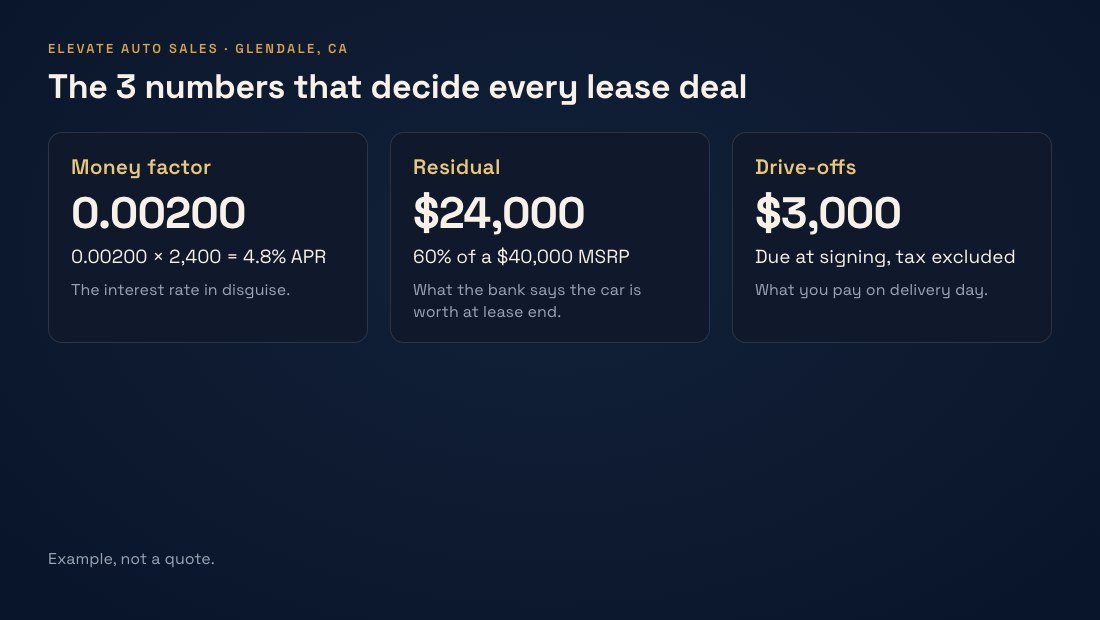
The money factor is the interest rate of your lease written as a small decimal, and multiplying it by 2,400 gives you the equivalent APR.
It is the interest rate wearing a disguise. A money factor of 0.00200 is 4.8% APR, and 0.00300 is 7.2%. Most contracts never print it, only the total rent charge, so few people know what rate they are paying.
Each month the bank publishes a base money factor, often called the buy rate, for every car, term and credit tier. The dealer is allowed to mark it up, and the markup never appears as its own line on the contract. That is how two identical cars with the same payment can still be different deals: one carries a marked-up money factor hidden behind a bigger drive-off.
We check the money factor against the bank's buy rate on every deal we shop. If you have a quote in hand, text a photo of it to (818) 797-9795 and we will work out what rate is inside it.
The residual is the bank's estimate of what the car will be worth at lease end, written as a percentage of MSRP, and you only pay for the value the car loses above it.
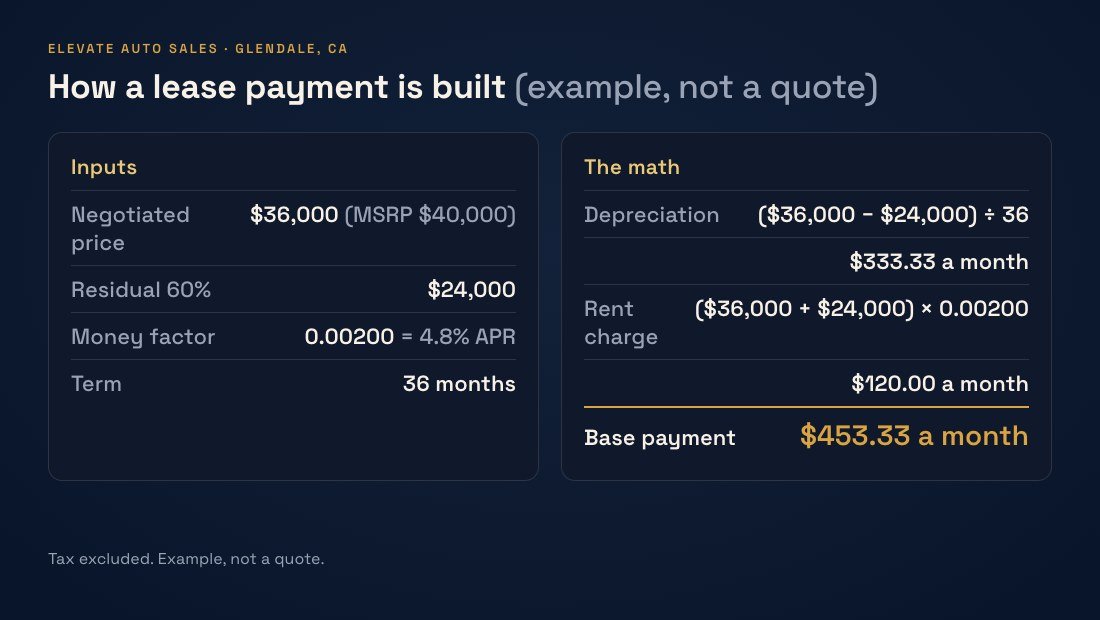
On a $40,000 car, a 60% residual is $24,000. Negotiate the price to $36,000 and you pay for $12,000 of depreciation, $333.33 a month over 36 months, plus rent charge. A high residual means you are only paying for the slice of the car you actually use.
The residual is set by the bank, not the dealer, and it moves with term and mileage: fewer miles a year usually means a higher residual. Banks also refresh their programs every month, so the residual on a car in September 2026 can be different in October, which is why timing matters more than haggling.
Residuals and the cars that lease best change every month, so sign up for deal alerts by text and we will tell you when a car's program turns in your favor.
Drive-offs are everything you pay on the day the car is delivered, and money down does not make a lease cheaper; it mostly moves the same cost to day one.
A typical drive-off covers the first month's payment, the bank's acquisition charge, registration, and anything left over as a capitalized cost reduction, the contract's term for money down. California taxes each payment and the cap cost reduction, so we quote every deal with tax excluded and add your city's rate when we write it up, including the LA County sales tax increase on October 1, 2026.
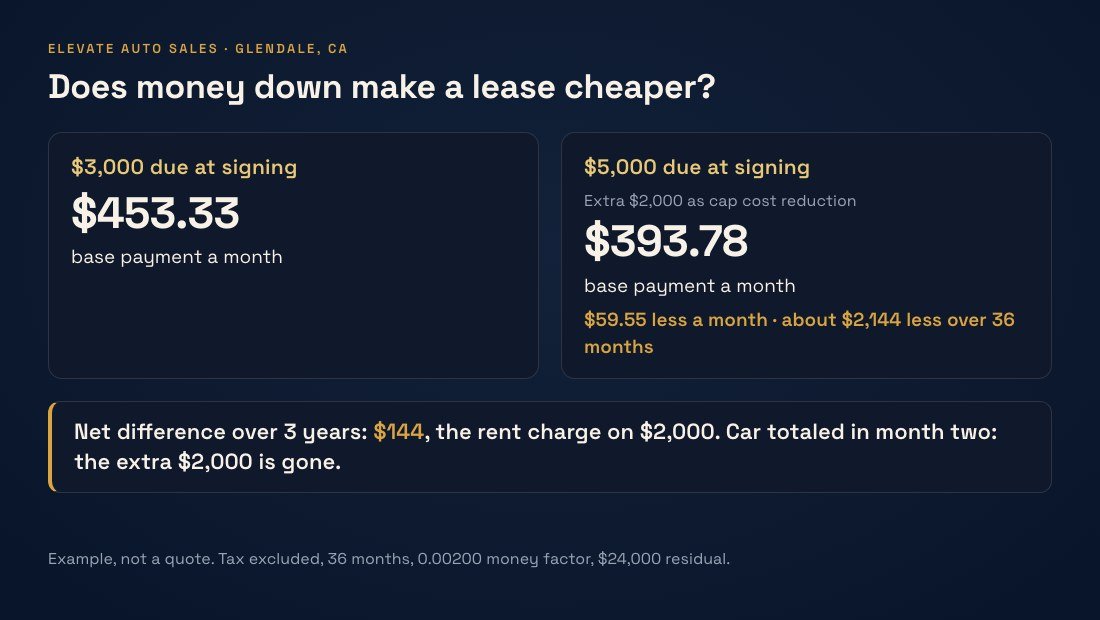
"Sign and drive" and "$5,000 down" can hide the same car. The first rolls the drive-offs into the price, so you pay them monthly with rent charge on top; the second buys a lower payment with money you handed over on day one.
On our example car ($36,000 price, $24,000 residual, 0.00200 money factor, 36 months), the base payment is $453.33 with none of the $3,000 going to cap cost reduction. Put in $2,000 more as a cap cost reduction and it drops to $393.78, or $59.55 a month. Over 36 months that is about $2,144 back for the $2,000 you put in, a $144 difference, which is just the rent charge on $2,000.
Now picture the car totaled in month two. Gap coverage settles what is still owed to the bank; it does not refund your down payment, so the $2,000 is gone.
That is why every deal we advertise is quoted the same way: $3,000 due at signing, tax excluded, nothing hidden in the fine print.
Your base payment is depreciation plus rent charge; here is the whole calculation on one example car.
Example, not a quote. A $40,000 car negotiated to $36,000, 36 months, 60% residual ($24,000), money factor 0.00200 (4.8% APR):
Now change one number at a time, same car, same price, same term, tax excluded.
| Example, not a quote | Clean deal | Marked-up money factor | Lower residual |
|---|---|---|---|
| Residual | $24,000 (60%) | $24,000 (60%) | $22,000 (55%) |
| Money factor (APR) | 0.00200 (4.8%) | 0.00300 (7.2%) | 0.00200 (4.8%) |
| Depreciation per month | $333.33 | $333.33 | $388.89 |
| Rent charge per month | $120.00 | $180.00 | $116.00 |
| Base payment | $453.33 | $513.33 | $504.89 |
| Extra cost over 36 months | $0 | $2,160 | $1,856 |
The marked-up money factor costs $60.00 a month and the lower residual $51.56 a month. Neither shows up on a window sticker, and neither is visible if all you see is the payment.
Send us your city and the model you want through Request a car and we will run all three numbers on the September 2026 program and show you exactly where the payment lands.
Because a payment can be dressed up to look like anything: add money down, stretch the term or trim the miles and a bad lease can show the same payment as a good one.
The payment is not the deal. The three numbers under it are.
At Elevate we negotiate hundreds of leases a month, and every one comes down to the same three numbers. We check the money factor against the bank's buy rate, confirm the residual, term and miles, and restate every offer as $3,000 due at signing, tax excluded, so two offers on the same car line up side by side. That is how an auto broker in Los Angeles works.
You never need to visit a dealership. We make dealers compete on price, negotiate with their fleet desks, write up the deal and deliver the car to your home or office.
The money factor you qualify for depends on your credit tier, so the cleanest first step is the credit application: it takes a few minutes and gets you approved before you settle on a car.
Here is how to put the three numbers to work with us.
A good money factor is the bank's base rate for your credit tier that month, the buy rate, with no dealer markup on top. Multiply it by 2,400 to see it as an APR, so 0.00200 is 4.8%. Because the base rate changes by bank, car and month, the real test is whether your quote matches the buy rate, which we check on every deal.
Multiply the money factor by 2,400. A money factor of 0.00250 times 2,400 is 6.0% APR. To go from APR back to a money factor, divide by 2,400, so 4.8% APR is 0.00200.
For the monthly payment, yes. You only pay for depreciation above the residual, so a higher residual means less depreciation inside your payment. The trade-off is that the residual is also the basis of your buyout price, so a high residual makes the car more expensive to keep at lease end.
Yes, but it mostly moves cost to day one. On a 36-month lease with a 0.00200 money factor, every $1,000 of cap cost reduction lowers the payment by about $29.78, which is $27.78 of depreciation plus $2.00 of rent charge. If the car is totaled early in the lease, that money is normally not refunded.
It usually covers the first month's payment, the bank's acquisition charge, registration and any amount left over as a capitalized cost reduction. The exact split depends on the bank and the car, and tax is added at the rate for the city where the car is registered.
The residual cannot be negotiated; the bank sets it for each car, term and mileage allowance. The base money factor is set by the bank too, but any dealer markup above it can be negotiated away, and that is one of the first things we check.
Because banks refresh their lease programs monthly, so the residual and money factor on a given car can both change, and manufacturer incentives move on a similar calendar. A car with a strong program in September 2026 can be an ordinary deal in October.
Keep reading: lease or buy a car in Los Angeles and the best lease deals in Southern California.